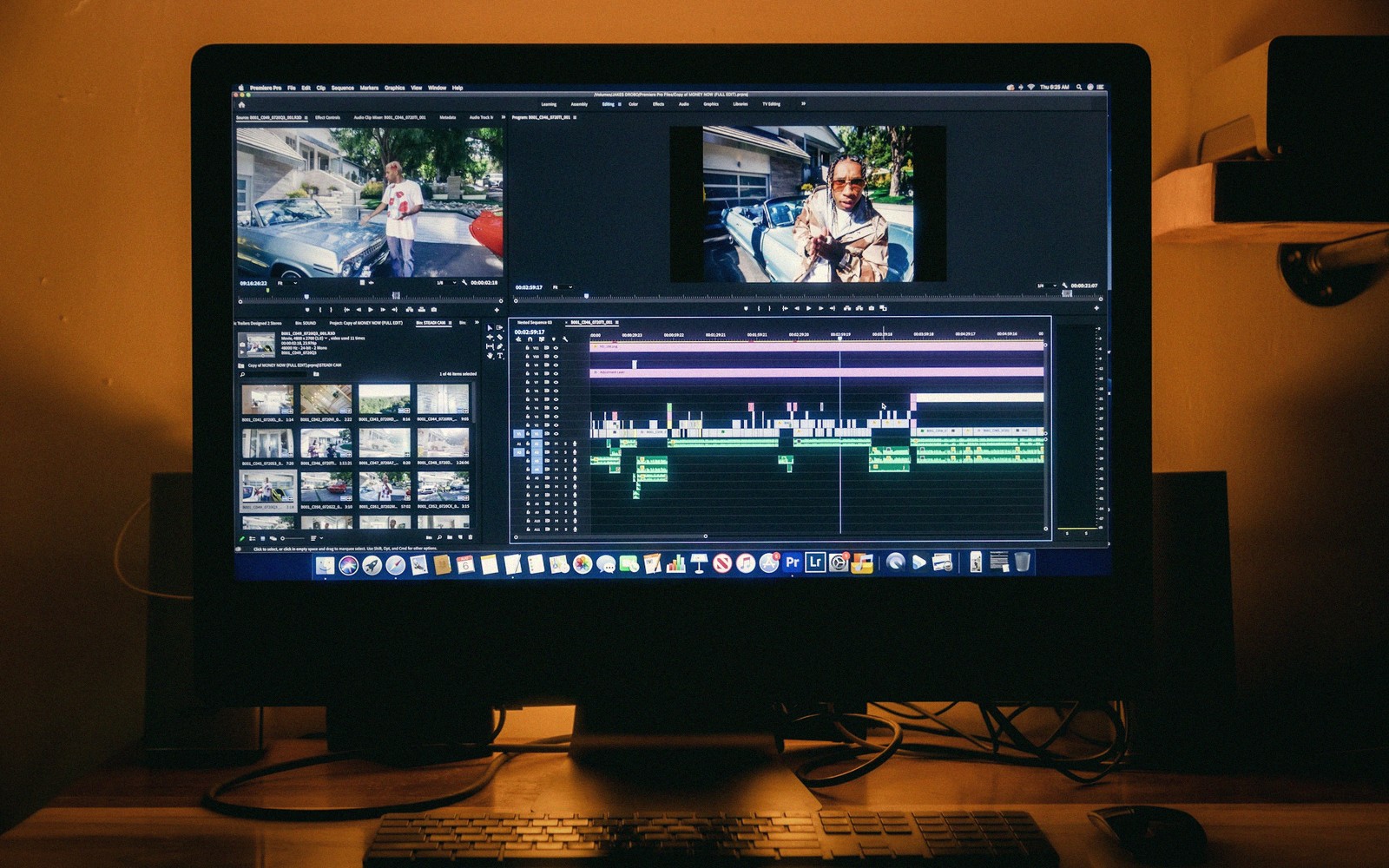
Where films are truly written — the cut that makes meaning between two shots.
The Invisible Art
There is a famous experiment, conducted by the Soviet filmmaker Lev Kuleshov in the early 1920s, that every film student eventually encounters. Kuleshov intercut the same neutral close-up of an actor's face with three different images: a bowl of soup, a coffin, a child at play. Audiences read hunger in the first pairing, grief in the second, joy in the third — though the face never changed. The meaning wasn't in the shot. It was between the shots. Editing, Kuleshov demonstrated, is where cinema thinks.
It is also where cinema hides. The craft's highest compliment is invisibility. A finely edited scene doesn't announce itself — you simply believe what you're watching, move through the story at the pace you should, and feel what the filmmaker intended without knowing why. This is what the American editor Walter Murch, in his essential short book In the Blink of an Eye, calls the "rule of six": the best cut satisfies the story's emotion, story, rhythm, eye trace, the two-dimensional plane of the screen, and three-dimensional space — roughly in that order of priority. Emotion, he insists, comes first.
How a Cut Makes Meaning
Editing is not simply removing the bad takes and joining the good ones. It is a second writing of the film — a recomposition of what was shot into something that may differ radically from the script. The legendary partnership between director Francis Ford Coppola and editor Walter Murch on Apocalypse Now (1979) is instructive: Murch and his team famously worked through enormous quantities of footage over many months, assembling a film that is substantially a product of the editing room as much as the jungle. The shape of the film — its rhythm, its dream-logic, its particular dread — emerged in the cut.
That rhythm is often what audiences feel but cannot name. A tightly cut action sequence achieves its exhilaration through brevity: shots held just long enough for the eye to register before the next arrives. A scene of grief, by contrast, needs duration — the held shot, the pause before the cut, the moment that cinema uniquely permits you to sit inside. Editors speak of "cutting on action" (matching a movement across a cut so the viewer barely perceives the join) and of the "L-cut" and "J-cut," in which audio from the incoming or outgoing scene crosses the visual boundary, softening transitions and weaving scenes together in time before or after the eye arrives.
The cut can also generate pure meaning through juxtaposition — what theorists call montage, a word that simply means "assembly" in French but which became, through the work of Kuleshov, Eisenstein, and Pudovkin in 1920s Soviet cinema, a full theory of film language. In Sergei Eisenstein's Battleship Potemkin (1925), the Odessa Steps sequence achieves its almost physical impact not through any single image but through the rhythm and collision of images — the boot, the baby carriage, the eye, the sabre — each shot given the duration of a musical note in a larger composition.
Craft You Can Learn to See
Editing becomes visible, paradoxically, in its violations. Jump cuts — in which a subject lurches forward in the frame because a portion of a continuous shot has been removed — were once considered errors. Jean-Luc Godard embraced them in Breathless (1960), using the jolt as expressive punctuation: restlessness, urgency, a world out of joint. Once you notice a jump cut, you can never quite un-see it, and the experience of recognising it as a choice is a small lesson in film literacy.
You can practise this kind of watching almost anywhere. In any scene of conversation, observe the cutting pattern: when does it cut away from the speaker to show the listener? The listener's reaction, chosen by the editor from available coverage, determines what the audience feels. If the editor cuts to a face that registers doubt, the speech sounds unreliable. Sympathy, scepticism, boredom — the edit assigns the emotional response, quietly, before you've made up your own mind. How to read a scene as a whole depends on recognising that the edit is always steering you, even when it feels like neutral observation.
Editing is the art form within the art form. It is the last rewrite, the hidden performance, the tempo of the whole. Great editors — Thelma Schoonmaker, Dede Allen, Michael Kahn, Anne V. Coates — are film authors in every meaningful sense, though the industry has been slow to say so. What they do is simultaneously mathematical and musical: finding the precise frame, within twenty-four of them per second, where a cut will land and feel inevitable rather than arbitrary. When it works, you don't see the edit. You just believe.
- Early 1920sKuleshov conducts his juxtaposition experiment in Soviet cinema
- 1925Eisenstein's Battleship Potemkin; Odessa Steps sequence as montage masterclass
- 1960Godard's Breathless reclaims the jump cut as intentional style
- 1979Apocalypse Now; Murch's assembly as model of editing-as-authorship
Lev Kuleshov
Soviet filmmaker; pioneer of montage theory and the named effect
Walter Murch
editor and sound designer; author of In the Blink of an Eye
Sergei Eisenstein
Soviet director; theorist and practitioner of intellectual montage
Jean-Luc Godard
French New Wave director; Breathless (1960)
Thelma Schoonmaker
long-time editor, career-defining collaborations with Martin Scorsese
Dede Allen
American editor; known for Bonnie and Clyde and New Hollywood work
Anne V. Coates
British editor; Lawrence of Arabia and beyond