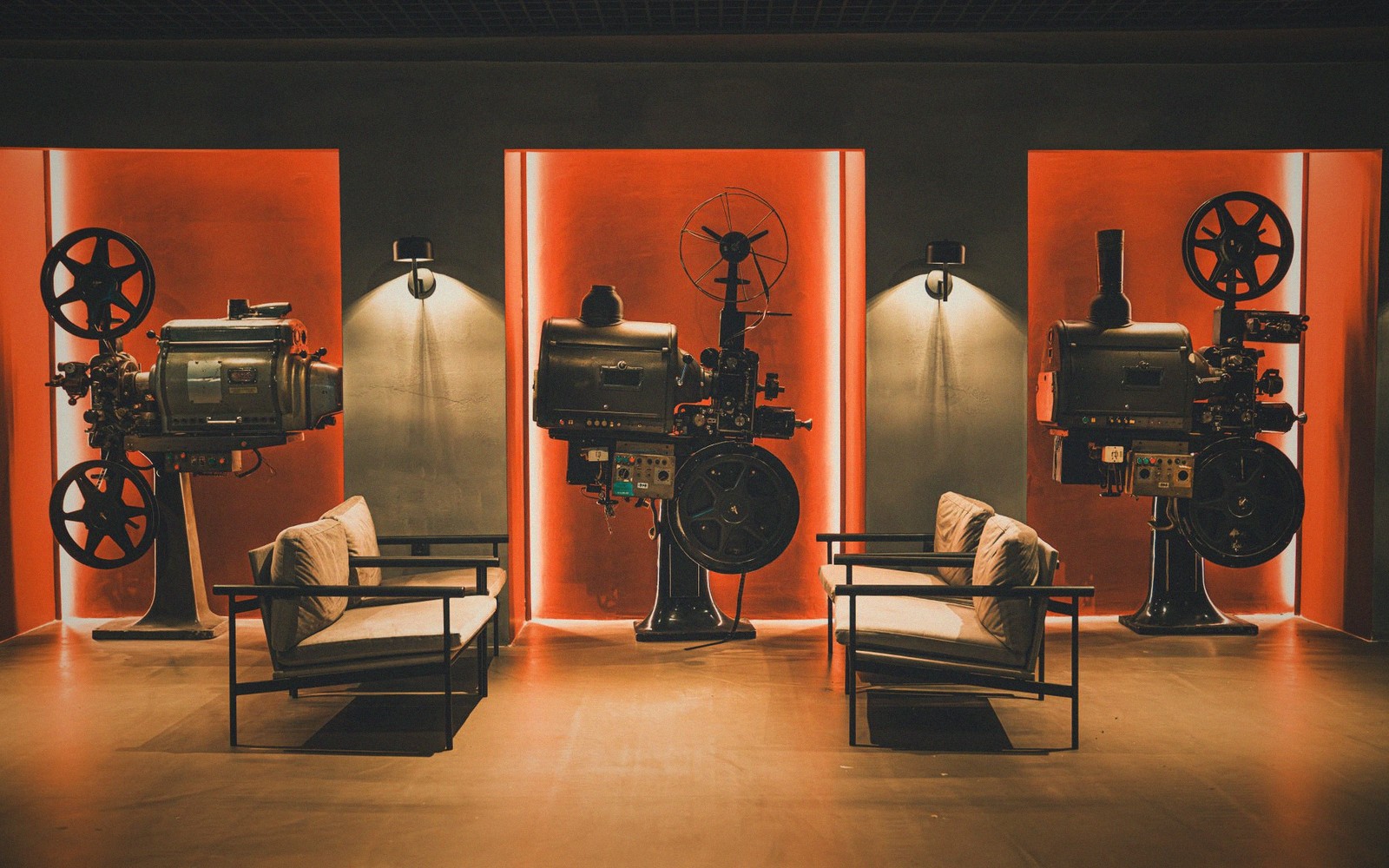
Five perforations per frame and a mile of silver — what the large format actually buys you in the dark.
The Frame That Fills Your Field of Vision
Pull a strip of standard 35mm film up to the light and the frame is roughly the size of a fingernail. Now do the same with 70mm: the image area is nearly four times larger, and you can feel the difference as much as see it. The gauge runs five perforations per frame rather than four, the emulsion is more finely grained, and the optical information packed into each exposure is extraordinary by any measure. When that image is projected at scale — genuinely large, the kind of screen that forces your peripheral vision into the picture — the result is less like watching cinema and more like being inside it.
This is not nostalgia talking. It is physics. A larger negative captures more detail than a smaller one, and a photochemical image holds information differently than a digital file. Where a compressed digital signal can introduce artefacts under stress — banding in shadows, halation that reads as a processing choice rather than a property of light — a 70mm frame simply contains more of everything: highlight detail, shadow gradation, the texture of fabric and stone and skin. When cinematography moves through a wide landscape or a complex interior, that extra real estate becomes visible as depth and weight rather than mere resolution.
A Format With a History Worth Knowing
The format's pedigree runs back to the late 1920s and the early experiments with widescreen photography, but 70mm found its commercial stride in the roadshow era of the 1950s and 1960s. Films were presented as events: reserved seats, printed programmes, an intermission scored to music. Lawrence of Arabia, 2001: A Space Odyssey, Ben-Hur — these were pictures built to exploit the format's scale, and the screen literally could not have contained them at any smaller gauge. Cinematographers designed compositions knowing the audience's eye would need room to travel.
The format contracted with the industry in the 1970s and 1980s, as multiplex economics made large-format projection impractical and expensive. But it never disappeared entirely. And in the twenty-first century, a handful of directors have insisted on it — shooting on 70mm negative, striking 70mm prints, demanding projection booths be rebuilt to house the machinery. Their reasoning is consistent: the format asks something of the audience that digital presentation does not. It requires surrender to the image.
What You Actually Notice in the Room
Sit in front of a properly projected 70mm print and the first thing that strikes you isn't resolution — it's presence. The image has weight. Colours carry a warmth and saturation that is native to the emulsion rather than corrected in a digital intermediate. The frame holds still in a particular way, steadied by the larger sprocket perforations and the sheer mass of the film moving through the gate. Even the grain, when it appears, looks like part of the image rather than a flaw in it.
There is also the sound. Roadshow 70mm presentations use a discrete six-track magnetic soundtrack, its quality a full generation above what optical 35mm can manage. The bass sits differently in the room.
None of this means digital projection is without value — it has its own clarity, its own virtues. But 70mm offers something genuinely different: an encounter with cinema as a material object, light through chemistry, a physical act of image-making that no streaming pipeline can replicate. When the revival house announces a 70mm screening, that isn't programming nostalgia. It is programming the real thing.
- Late 1920searly experiments with widescreen and large-gauge photography
- 1950s–1960sgolden era of 70mm roadshow presentations
- 1970s–1980sformat contracts as multiplexes make large-gauge projection impractical
- 2000s–presentselective revival by filmmakers insisting on 70mm production and projection
Lawrence of Arabia
1962
landmark 70mm production, directed by David Lean
2001: A Space Odyssey
1968
Kubrick's large-format space epic, shot and presented in 70mm
Ben-Hur
1959
roadshow-era epic filmed in Camera 65/Super Panavision 70