America's founding myth on horseback — and how the genre turned to question itself.
Open Country, Loaded Meaning
No genre is more American, and none more dishonest about what America is. The Western was Hollywood's dominant form for roughly half a century, and it earned that dominance through sheer mythic power: wide skies, hard men, the horizon as moral absolute. At its simplest, the genre promises a world where good and evil are as legible as a white hat and a black one. At its most searching, it turns that promise inside out.
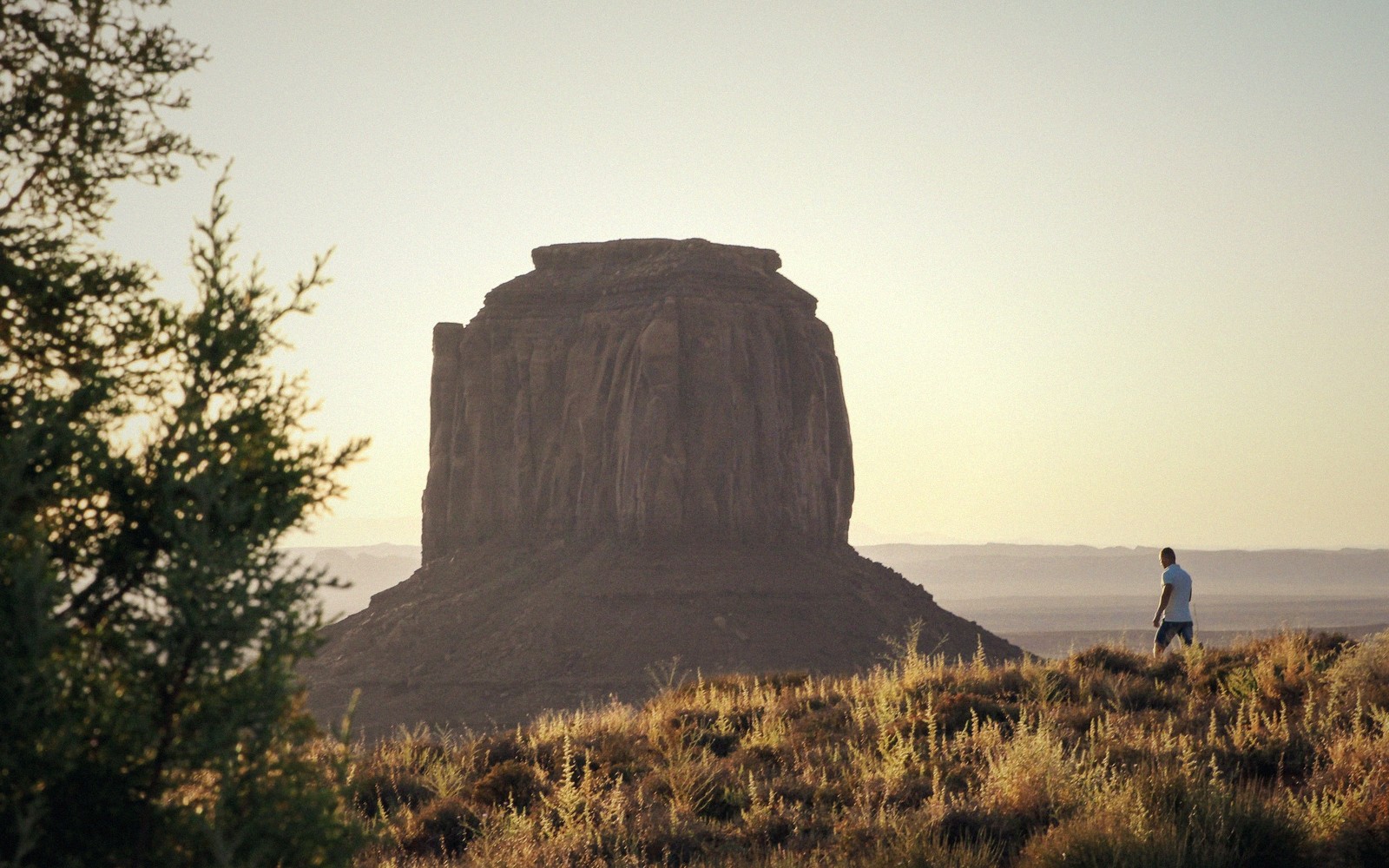
The Western's grammar is topographic. The landscape isn't backdrop; it is argument. Monument Valley — those sandstone buttes in the Navajo Nation straddling Utah and Arizona — became, through John Ford's repeated use of it from the late 1930s onward, almost a sacred space in the American cinematic imagination. Vast, indifferent, beautiful: the land dwarfs its settlers while somehow ratifying their presence. That is the Western's central trick, and its central lie. The frontier myth holds that this space was empty, available, awaiting civilization. The films had to work hard to sustain that fiction.
At the genre's structural heart is the tension between wilderness and settlement, between the lone individual and the community that needs him. The hero rides in, resolves the violence, and cannot stay — his very capacity for violence disqualifies him from the domestic world he has protected. Shane (1953) articulates this with an almost painful clarity; so does The Searchers (1956), which goes further, twisting the hero's obsession into something genuinely troubling. Both films show the myth straining against its own logic.
The Genre Talks to Itself
By the mid-1960s, the Western was ready to interrogate its own assumptions, and the conversation arrived from an unexpected direction: Italy. Sergio Leone's Dollars trilogy, beginning with A Fistful of Dollars in 1964, stripped the genre of its moral earnestness. The landscape was still operatic, but the hero — laconic, mercenary, violent for pay — was a deliberate deflation of frontier nobility. Leone's West is a baroque theatre of death, the close-up held until it becomes absurd, the score by Ennio Morricone doing as much moral work as the screenplay. These Spaghetti Westerns, shot largely in Spain and on the cheap, made more money and asked harder questions than many of their American counterparts.
Hollywood noticed, and the genre turned on itself. Sam Peckinpah's The Wild Bunch (1969) is the watershed: a group of aging outlaws, obsolete in a modernizing West, riding toward a destruction they almost choose. The film's editing — intercutting slow-motion carnage with brutal speed — made screen violence feel simultaneously gorgeous and horrible, implicating the viewer in the spectacle. The frontier romance was dead; what replaced it was elegy. The Western had become a genre mourning the myth it had built.
That turn toward revision never entirely stopped. Films like McCabe & Mrs. Miller (1971) used the Western's forms to expose the genre's silences — about capitalism, about women's lives, about the grinding reality behind the pioneer legend. Little Big Man (1970) gave a pointed, belated account of Indigenous experience. The heroes shrank; the violence lost its redemptive glow; the landscape remained magnificent but no longer complicit.
What Endures
The Western has never quite died, though critics have announced its death repeatedly since the 1970s. It resurfaces because the questions it carries don't go away: Who gets to define civilization? What violence is permissible in its defence? Who is erased from the founding story? Clint Eastwood's Unforgiven (1992) used the genre's conventions to methodically dismantle the mythology of the gunfighter — only to reinstate it at the climax in the very act of destruction, proving that the myth has physical weight even when you know it's a myth.
More recently, filmmakers have pushed that revisionism further, foregrounding the perspectives the classical Western systematically excluded. The result isn't the end of the genre but its expansion: the same open country, the same structural confrontations, the same moral weather — but different people standing in the light.
For the film-curious viewer, the Western is one of cinema's great tutorial genres. Because its iconography is so well-established, any deviation from convention is immediately readable as a statement. The slouch of a saddle, the moment when a hand moves toward a holster, the question of who the camera follows into town — all of it carries accumulated meaning. Learning to read a scene in a Western is learning to read genre itself: every choice is a negotiation with what came before.
The genre endures because the myth endures — not as truth, but as a story America keeps needing to tell and retell, arguing with itself in wide-screen and primary colours. The frontier is closed; the Western is not. It rides on, carrying its contradictions like saddlebags, still asking what it means to call a landscape yours, and what it cost.
- Late 1930s onwardFord establishes Monument Valley as Western's iconic landscape
- 1953–1956Shane and The Searchers push classical Western to its expressive limits
- 1964–1969Spaghetti Western era; Leone and Peckinpah transform the genre
- 1970–1971revisionist wave: Little Big Man, McCabe & Mrs. Miller
- 1992Unforgiven; genre deconstructs and yet reinstates its own mythology
Monument Valley
sandstone butte landscape in Navajo Nation, Utah/Arizona; Ford's signature location
John Ford
director who defined the classical Hollywood Western's visual and moral language
Sergio Leone
Italian director whose Dollars trilogy revolutionised the genre's tone
Ennio Morricone
composer whose scores for Leone's Westerns are inseparable from their meaning
Sam Peckinpah
director of The Wild Bunch; redefined screen violence and Western elegy